-
Saturday, Feb 28, 2026
“There is a part of you that too easily gives in to others’ influence. As soon as someone questions your motives, you start doubting yourself. You end up agreeing with the other before you have consulted your own heart. Thus you grow passive and simply assume that the other knows better. Here you have to be very attentive to your inner self. “Coming home,” and “being given back to yourself” are expressions that indicate that you have a solid inner base from which you can speak and act – without apologies – humbly but convincingly.” The Inner Voice of Love, Henri Nouwen, pg 38
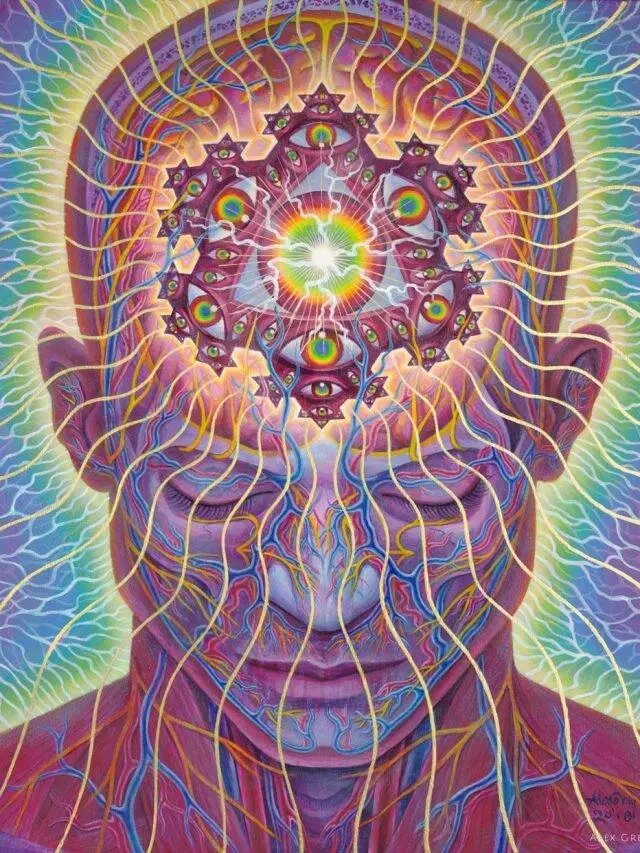
The Seer 2020, Alex Grey
“For all ministers are called to recognize the sufferings of their time in their own hearts, and make to that recognition the starting place of their service. Whether we try to enter into a dislocated world, relate to a convulsive generation, or speak to a dying person, our service will not be perceived as authentic unless it comes from a heart wounded by the sufferings about which we speak.” The Wounded Healer, Henri Nouwen pg 6
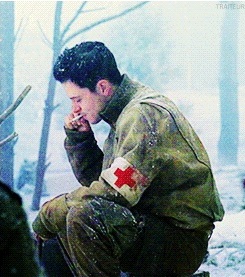
Eugene “Doc” Roe as portrayed in Band of Brothers
“My gift became my curse and yet it is still my greatest gift, and it seems that I cannot have one without the other.
One knows oneself only at the price of one’s innocence.”The Sacred Ennegram from the Foreward by Richard Rohr, pg 11
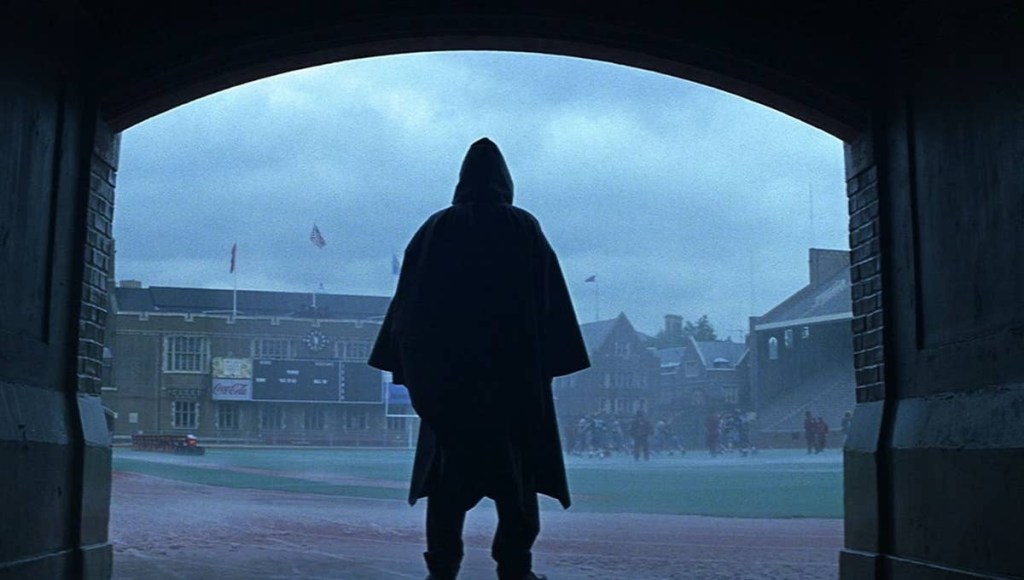
Unbreakable 2000
“To care is to be present to those who suffer, and to stay present, even when nothing can be done to change their situation.”
“One of the great riches of caregiving is that it embraces something more than simply a focus on cure.”
A Spirituality of Caregiving, Henri Nouwen, pg 16
-
L’appel du vide (French for “the call of the void”)
Starting a new year has always drawn me to begin new unsustainable habits. This year (2026) is no different. Here, afresh, I have the false hope that I will write more, read more, work out more, think more, be more, etc.
Don’t be confused, I’m not without hope. In fact, it is now that my hope is at its highest crest. The blank canvas of 364 calendar pages is a kind of “full gas tank” to speed me towards amazing imaginary future destinations.
But at the age of 51, I know myself too well. Have been here too often. And I know the “miles per gallon” I have achieved in the past won’t take me all that far.
Abraham of the bible, in his journey from Ur to Canaan and Egypt, covered thousands of miles over many years.
Abraham Lincoln in 1861 alone, travelled nearly 2,000-mile on a 13-day train ride through seven states (IL, IN, OH, PA, NY, NJ, MD) to D.C.
Counting airplane trips, I’m sure I’ve travelled further than both Abrahams combined… but distance travelled geographically isn’t the same as distance travelled internally.
So this year, I want to idle more, burn some of that fuel tank just taxiing on the runway. I want to make sure I’ve got my internal bearings before heading down the runway.
A reoccurring motif in what I’ve been reading and hearing lately has to do with an abyss. An internal hole that can’t be filled.
“If you gaze long enough into an abyss, the abyss will gaze back into you.” -Friedrich Nietzsche
“There is a deep hole in your being, like an abyss. You will never succeed in filling that hole, because your needs are inexhaustible. You have to work around it so that gradually the abyss closes.
Since the hole is so enormous and your angst so deep, you will always be tempted to flee from it. There are two extremes to avoid: being completely absorbed in your pain and being distracted by so many things that you stay far away from the wound you want to heal.” -Henri Nouwen

As I’ve thought about my own abyss, two images that come to mind.
The first image is of a colander, a bowl filled with holes, and my hands around the holes, desperately trying to keep the water in the bowl. In this picture, my heart is the colander and the water flowing through the holes is my happiness, my energy, my love, my everything and I can’t keep it in the bowl. So instead of trying to hold the bowl’s holes shut, I distract myself.

The other image of an abyss is more menacing and terrifying:
A singularity is the theoretical center of a black hole, a point where mass is crushed to infinite density and zero volume, causing gravity and spacetime curvature to become infinite, and where our current laws of physics (General Relativity) break down.
Do you have pain like this in your life? Where the current understanding of life breaks down and makes no sense? A point of infinite emotional density, zero empathy, no up or down, just endless freefall into nothing?
It’s awesome (in the old meaning of the word) and terrible to behold.
How can I stop the water from flowing out of my colander heart? How can I tiptoe to the edge of something that engulfs even light rays and peer into it’s utter darkness?
Carefully. Slowly. Deliberately. With great caution. With assistance at times.
I step towards the edge and feel the woozy “L’appel du vide”… the call of the void… the fleeting feeling of an urge to do something dangerous or self-destructive.
And each time I approach, observe and safely retreat from this terrifying edge of all my pain, I am stronger for the journey.
As Henri Nouwen writes, “Since the hole is so enormous and your anguish is so deep, you will always be tempted to flee from it. There are two extremes to avoid: being completely absorbed in your pain and being distracted by so many things that you stay far away from the wound you want to heal.”
Instead he writes: “You have to work around it so that gradually the abyss closes.“
So for my 2026, I will not be burning up my full gas tank of 364 days by running from the void, or aiming directly into it’s self-destructive center. Instead I will take a circuitous route.

It will not be the most direct path toward or away from my pain. I will circle it, slowly… indirectly… observing it, poking it, touching it, healing it.
And I hope the wound(s) will become smaller and smaller with each circumnavigation of the abyss. And I hope the same for you in this new year.
-
“I sound my barbaric YAWP over the roofs of the world.” -ww
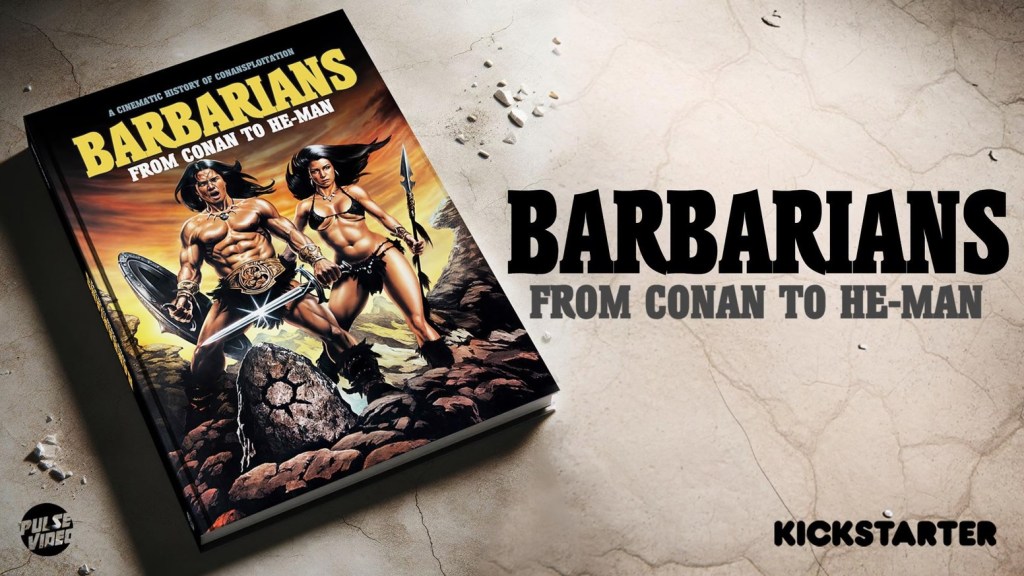
Yesterday I received my copy of a Claude Gaillard’s Kickstarter book BARBARIANS: From Conan to He-Man and I’m already enjoying the thoughts its provoking.
The movie Dead Poets Society shared Walt Whitman’s defiant YAWP that is ours to shout over the rooftops of the world. But I didn’t know much about this YAWP myself. The civilization… the “cult”ure I was in at the time had redefined this YAWP and it was years until I understood what it meant.
In the book, Claude writes: “Visible and presumed strength – as well as violence – form the core of the barbaric operas. This idealized barbarism undoubtedly sheds light on our psyches, revealing the primal instincts that centuries of Western cultural construction have attempted to conceal: the animality from which we mistakenly believed we have divorced, but which resurfaces with each historical upheaval. Freedom – individual freedom – is priceless. Through the barbarian characters and for the duration of a film, we thus consented to sacrifice a considerable part of what makes our societies, but which we sometimes perceive as chains. When the lights of the movie theater turn back on, we hurriedly return to the sweet servitude of our modern world with one certainty in mind: to live without faith, without law, without God, without a master, must be an exhausting experience. A constant struggle we don’t really want to experience, but to which we still aspire! The human soul doesn’t mind a contradiction.“
This contradiction reveals itself in our entertainment selections. Comic book characters like the Punisher, or literary-to-screen heroes like Jack Reacher show the modern day equivalent of a righteous barbarian, a self-sufficient, self-answering vigilante, who can stand up for the innocent, literally might making right.
Reminds me of Jordan Peterson’s comments on might not only making right, but as the only way to be right.
However this can create a contradiction as might isn’t always right.
I’ve met Mike Pence… and agree or disagree with the man.. he is a man, a human, just like you or me… an angry mob chanting “Hang Mike Pence” isn’t the freedom that Conan, Jack Reacher or other barbarians offer us.
So the barbarian is a contradiction as a role model. Claude writes that the barbarian “connotated, the foreigner, the invader, the other, as well as the savage and the cruel, the uncouth and the uncultured.“
Ragnar and his pagan ways exemplifies this contradiction… he is foreigner and invader… but his curiosity and drive to learn spares one life and opens a new world of politics and expansion. Old King Conan takes the throne.
So how does this tension play out in every day life? As parents, we inculcate children whom we dwarf with our size and power. We all come in to life completely helpless, depending on the power of adults to feed us, change us, raise us, support us. The adults in the room are right, even if they are wrong. The adults in the room are like gods to us, until we finally grow ourselves and realize they are fallible just like us. Perhaps they didn’t even want to be the adults in the room… had not processed their own journey to parenthood, responsibility and took their trauma out on the ones they were meant to protect.
“Freedom – individual freedom – is priceless” writes Claude and the barbarian expresses that freedom, by his otherness. His tongue is different. He doesn’t care for the local cultures or customs. He sees raw assets in the monuments. He takes the value out of the symbols and reduces them to physical raw material.
2 Kings 25:8-21 The Destruction of the Temple
8 On the seventh day of the fifth month of the nineteenth year of King Nebuchadnezzar of Babylonia, Nebuzaradan, adviser to the king and commander of his army, entered Jerusalem. 9 He burned down the Temple, the palace, and the houses of all the important people in Jerusalem, 10 and his soldiers tore down the city walls. 11 Then Nebuzaradan took away to Babylonia the people who were left in the city, the remaining skilled workers,[b] and those who had deserted to the Babylonians. 12 But he left in Judah some of the poorest people, who owned no property, and put them to work in the vineyards and fields.

13 The Babylonians broke in pieces the bronze columns and the carts that were in the Temple, together with the large bronze tank, and they took all the bronze to Babylon. 14 They also took away the shovels and the ash containers used in cleaning the altar, the tools used in tending the lamps, the bowls used for catching the blood from the sacrifices, the bowls used for burning incense, and all the other bronze articles used in the Temple service. 15 They took away everything that was made of gold or silver, including the small bowls and the pans used for carrying live coals. 16 The bronze objects that King Solomon had made for the Temple—the two columns, the carts, and the large tank—were too heavy to weigh. 17 The two columns were identical: each one was 27 feet high, with a bronze capital on top, 4½ feet high. All around each capital was a bronze grillwork decorated with pomegranates made of bronze.

18 In addition, Nebuzaradan, the commanding officer, took away as prisoners Seraiah the High Priest, Zephaniah the priest next in rank, and the three other important Temple officials. 19 From the city he took the officer who had been in command of the troops, five of the king's personal advisers who were still in the city, the commander's assistant, who was in charge of military records, and sixty other important men. 20 Nebuzaradan took them to the king of Babylonia, who was in the city of Riblah 21 in the territory of Hamath. There the king had them beaten and put to death.

So the people of Judah were carried away from their land into exile."
As the Babylonians and the Jan 6 rioters show, human might does not always make right. Power corrupts… but the barbarian holds some promise that our raw strength can be used for good.
Claude writes: “It is worth noting that the uniqueness of the barbarian and the allure he held over the public went beyond his affinity for swift self-justice. No, it was all part of something larger, more potent and more radical. Barbarian cinema took us back to square one. These journeys into primitive and medieval times, albeit imaginary, opened the door to a little more freedom than the constraints of today’s world allow. Freed from the shackles of civilization, predetermined rules and sometimes burdensome political correctness, one could reclaim control of the destiny. The concept of a blank slate awaiting new narratives, lay at the heart of post-apocalyptic cinema – a genre closely related to the celebration of this new barbaric age.“
It is this “blank slate” what if there were no rules aspect of barbarism that I do embrace… in every situation, using my might to make (as best as I can interpret it) right and using that strength to protect and raise those to also wield their freedom aright. To help them to sound their own YAWP across the roofs of the world. And to make this world, whatever it is, a better place for all of us… as Walt Whitman says, in the same poem….
I bequeath myself to the dirt to grow from the grass I love,
If you want me again look for me under your boot-soles.

You will hardly know who I am or what I mean,
But I shall be good health to you nevertheless,
And filter and fibre your blood. -
Solo Adventures – Cousin to gamebooks
Since gamebooks with game mechanics are arguably directly derived from RPGs in general (and often D&D specifically), I am always on the look out for the cousin to gamebooks in the form of the RPG “solo adventure.”
I need to double check if Mark Lain addresses this in his (hopefully) annual Gamebook Collector’s Check List and Price Guide (2024 edition available now on Amazon) but I would say the big difference is these solo adventures are NOT in a separate smaller book form.
RPG solo adventures might be a standalone module that is A4 or 8.5×11 sized. Or there are some GURPS solo adventures that are even perfect bound at that size.
But these are NOT ”pocket sized” gamebooks in the ilk of Fighting Fantasy, Lone Wolf or Sagard, etc.
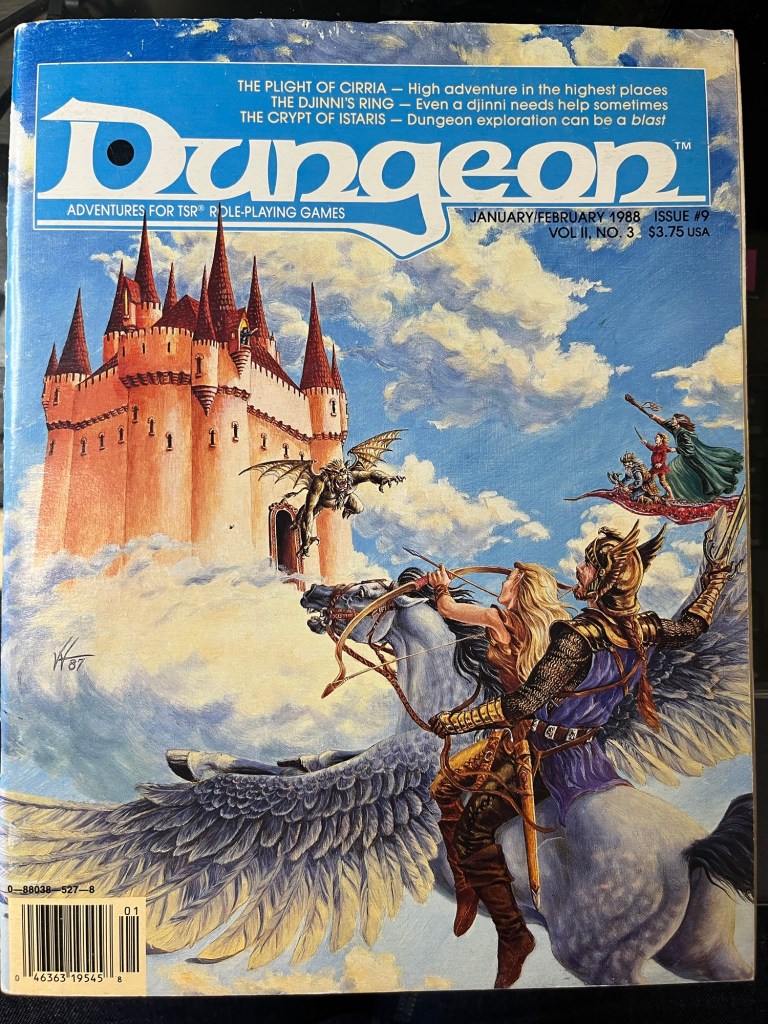
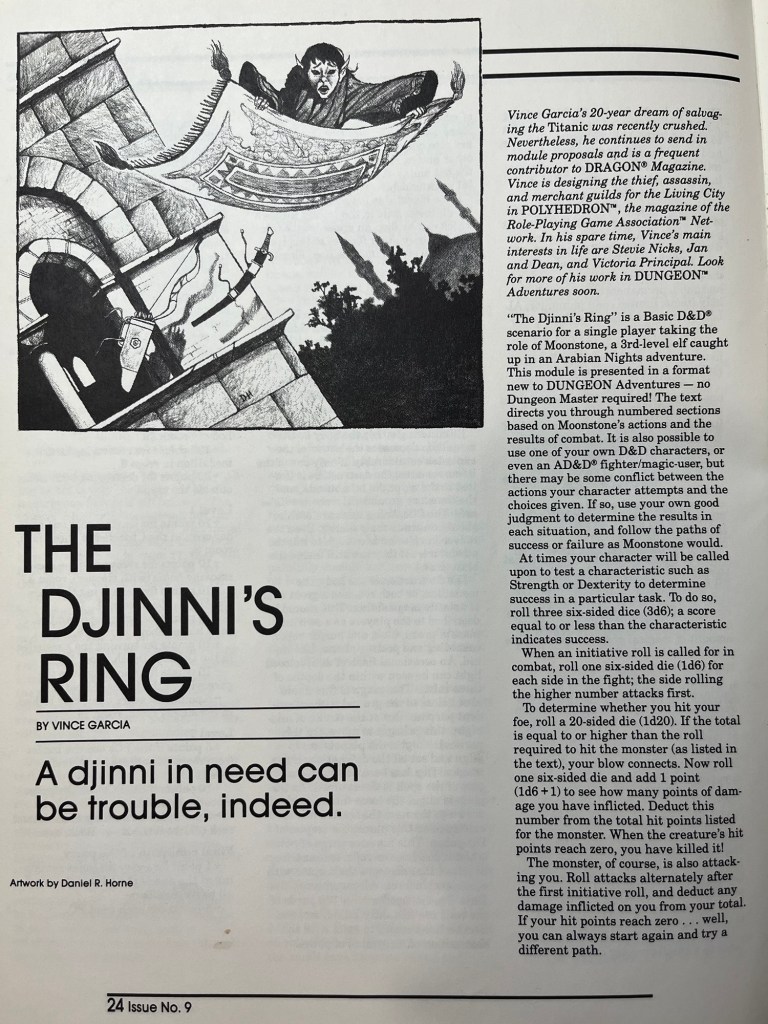
Tonight I’m sharing another format for RPG solo adventures with the first ever appearance in Dungeon magazine, Vol II, No. 3, issue #9 (which is kind of a confusing numbering method!)
Dated as the Jan/Feb 1988 issue, the table of contents lists The Djinni’s Ring (D&D 3-Solo) and says “Our first solo adventure – no DM required!”
D&D released other solo adventures as standalone modules, sometimes with the mechanism of an enclosed highlighter style pen that could reveal hidden text after a narrative choice was made. See “Blizzard Pass” M1 from 1983.
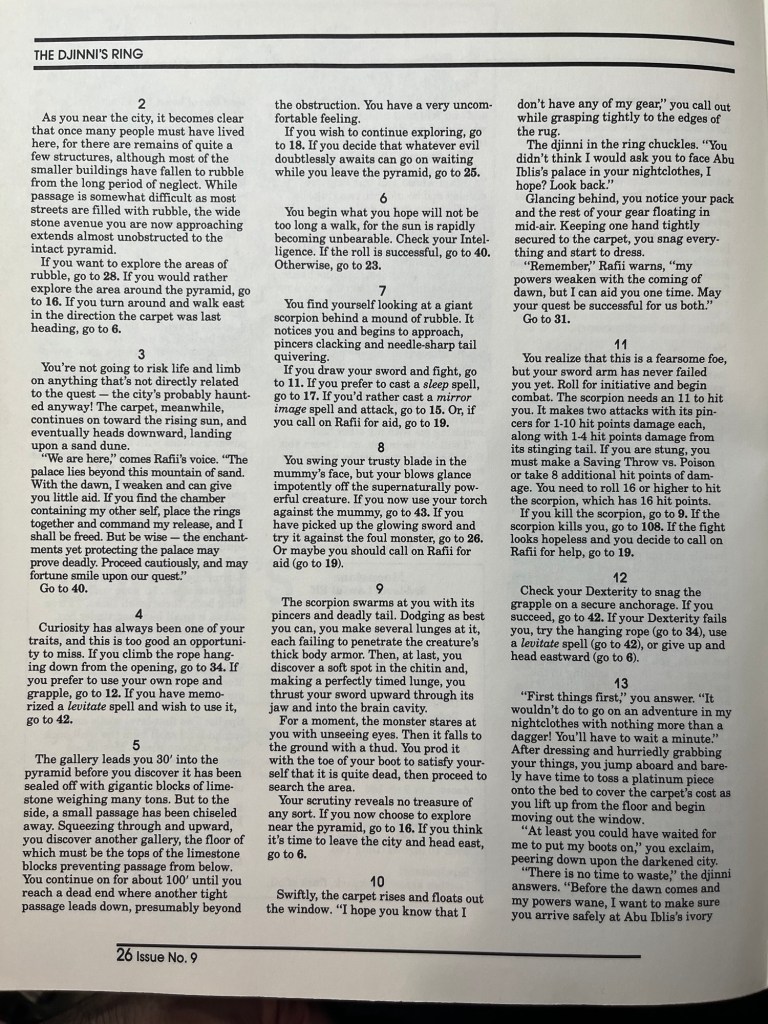
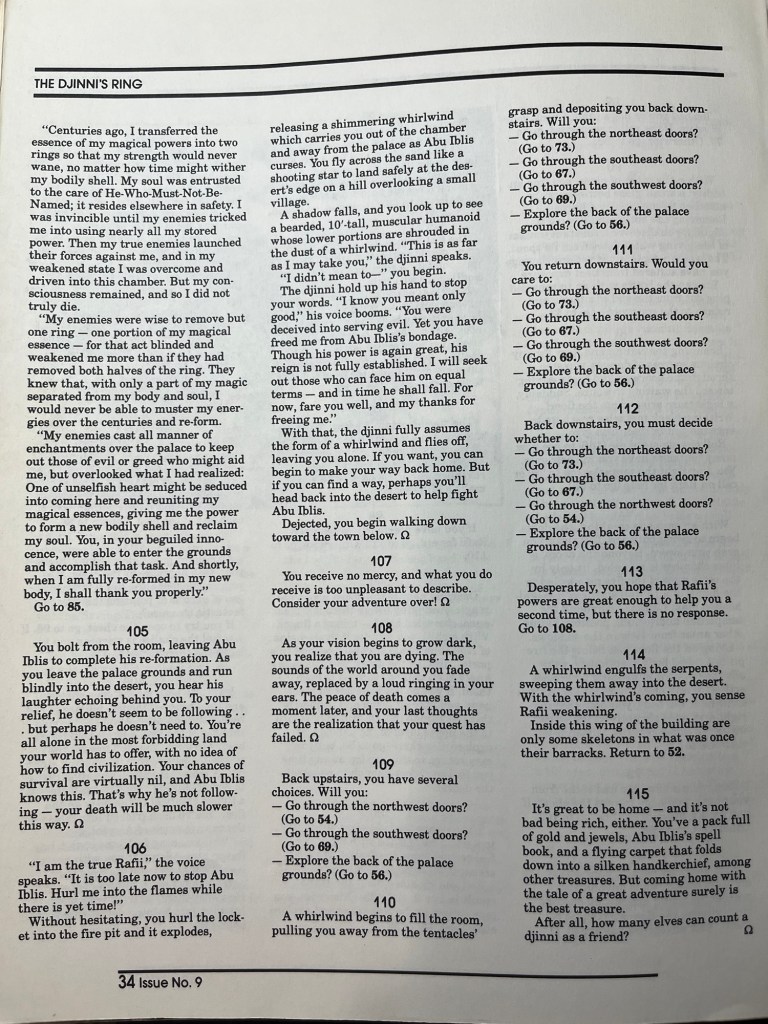
But here are some photos from this adventure and the familiar gamebook style of numbered passages brings a smile to my face. Enjoy! ⚔️
-
August 26, 2023 – Nest Poem (a reflection on my young adult sons)
Do birds return to their old nest?
And stand upon the twiggy crest,
To gaze at what once seemed so high
When their little wings could not fly.
How small their nest world once was,
Stranded in a tree, far above,
The dizzying heights being up so tall
And certain death from clumsy fall.
But now with wings mature and fully spread,
They leave their feathery, twiggy bed
And soar to new heights, explore the sky
Upon the dizzying heights, now they fly!
And mastering this empire of air,
Where gravity is no longer a care,
They return to humble twiggy nest,
Remembering this was all just a test.
For those who learn and leap and dare,
Will leave their nest for the empire of air,
And no one can ever clip your wings,
once from the nest you bravely spring!
So if you return to small twiggy hovel,
Tired from all your global travels,
And wonder how it all started here,
It’s because you chose flight over fear
-
February 11, 2023
Passion – Patient – Addiction – Freedom
Reading James 4:1-10, I saw the word “passion” appear several times. From the Late Latin “passio-” meaning suffering, it may have come from earlier Latin “pati-” meaning to suffer, where perhaps we also get the word “patient” also possibly from the Greek “pema” meaning suffering.
So a patient is one who suffers. One who is suffering must have patience… the ability to withstand or endure the suffering. But how does this connect to passion?
James 4:1-10 says that our passions are at war within us and this war causes fights amongst us. These passions and desires for things we don’t have cause us to murder, fight, quarrel and covet.
These passions seem to lead to suffering! People talk about a “passion project” and they typically mean it in the context of a hobby or personal undertaking that COSTS them a lot of time, money… or said another way, pain.
The pain of the passion project is what oddly validates our love for it, no?
In an article by Edward T. Welch called Motives: Why Do I Do the Things I Do, he writes, “Addicts may be enslaved, but, at some level, they volunteer to be.”
Just like the person with the passion project… they have chosen this pain, this extreme investment of their OWN choosing. It was not required by their employment and their immediate family may not understanding the drive behind the passion project.
The passion… the voluntary suffering… the voluntary addiction… for selfish pursuits. This is what James is referring to as what causes quarrels, fights, coveting, murder.
Other quotes from the Edward T. Welch Motives article that stood out to me were:
- “Here is a general principle: your attitude toward God will be revealed in your worst human relationship.”
- “…no one has to be taught idolatry: we figure it out all by ourselves.”
- “If you think about the things that have led to change in your life, you will probably find that people were usually the catalyst.”
This last point got me thinking as I have often seen this to be the case in life. For myself, getting married certainly led to changes. But having children? That really caused a lot of changes in myself as I realized the responsibility of being a provider, nurturer, guardian for these little lives.
Edward T. Welch goes on to write that “A growing knowledge of a spouse or friend leads us to acts of love.” Other people can become our passion. They can become what we patiently endure, expend time and treasure to help, and this process changes US in the process.
He wraps up the article discussing that while discovering and knowing our motives has value, our efforts should be primarily focused on knowing God, looking at Christ, growing in the knowledge of Him.
For some reason, I wondered about this… is our alone time spent with God in some sense “selfish”? Are we pursuing what’s good for us and neglecting our service, our passion, for other people?
But God did say things like love your neighbor AS you love yourself.
In Ephesians 5, the discussion of the relationship of marriage, Paul writes “In the same way husbands should love their wives as their own body. He who loves his wife loves himself. For no one ever hated his own flesh, but nourishes and cherishes it, just as Christ does the church.”
So there seems to be an interesting dichotomy between our inward focus on our own relationship with God and our outward focus on our relationships with other people.
The analogy from the airline flight attendant who describes that in case of an emergency, you must first put on your own mask before helping the passenger (even a child) next to you comes to mind.
God is our oxygen. If we are using all of our time on our own special passion projects or if we don’t spend ANY time ingesting His air into our needy lungs, our empty brains, our cold hearts… how then will we have any energy for those in our own household, let alone the wider world?!
A different book I’m reading, GenX Religion by Richard W. Flory and Donald E. Miller, which is specific to how my generation (anyone born from 1965 to 1980) has grown to consider religion, illustrates this exact point:
“Xers are not afraid of the truth, nor are they fooled into thinking they can change the world. They have by and large given up on large-scale utopian schemes and are working for practical change in their own lives, those of a few close friends, and, when feeling expansive, that of their neighborhood. Thus there exists a duality within their mentality: the coexistence of harsh realty and a desire and hope for better days. They respect people who live below the hype of expectations. Indeed, this is a cynical generation, but it is this way because it wants something more from relationship and people in authority.”
I posit that those in their mid/late 40’s and early 50’s are looking for change in their own lives, and often that is motivated from a desire to be more useful in the lives of those they love.
Also much effort is spent in counseling, thinking, scrolling to simply feel good about one’s self. In the case of overcoming trauma during formative years, this is completely healthy and understandable.
But in all forms of self-improvement is the danger of focusing too much on our own passion… to forever remain a “patient” and not become a “wounded healer” as the saying goes.
“Submit yourselves therefore to God. Resist the devil, and he will flee from you. Draw near to God, and He will draw near to you. Cleanse your hands, you sinners, and purify your hearts, you double-minded. Be wretched and mourn and weep. Let your laughter be turned to mourning and your joy to gloom”
Why?
“Humble yourselves before the Lord, and He will exalt you.”
That’s why. The laughter of our shallow social media habits… the joy of our personal passion projects (my comic books included) cannot be a substitute, cannot become or remain an idol, that keeps us from drawing near to God.
Our dirty hands and double-minded brains will keep us from coming to Him.
Our dirty hands can’t reach the oxygen of His truth… we won’t single-mindedly focus on true LOVE OF OURSELVES in the sense that we want to be ABLE to LOVE OUR SPOUSE or child, or someone in our household, or… if we’re feeling expansive, someone in our neighborhood.To look to God, to humble ourselves, is, in a sense, the best thing we can do for ourselves and positions us for usefulness in the disasters that befall the passengers next to us on this long flight we are all on together.
-
January 2, 2023
Monday – Posted on LinkedIn that 2023 will be the year of human connection.
Every day is full of numerous human touch points. There is some unnameable joy in helping a stranger with no future ties or immediate remuneration. How many times have you helped someone and not realized that their journey may be more important than yours.
Then the King will say to those on his right, ‘Come, you who are blessed by my Father, inherit the kingdom prepared for you from the foundation of the world. I was naked and you clothed me, I was sick and you visited me, I was in prison and you came to me.’ Then the righteous will answer him, saying, ‘Lord, when did we see you hungry and feed you, or thirsty and give you drink? And when did we see you a stranger and welcome you, or naked and clothe you? And when did we see you sick or in prison and visit you?’ And the King will answer them, ‘Truly, I say to you, as you did it to one of the least of these my brothers, you did it to me.’
https://www.biblegateway.com/passage/?search=Matt.25.34,Matt.25.36,Matt.25.37,Matt.25.38,Matt.25.39,Matt.25.40,Matt.25.35&version=ESV -
January 1, 2023
Happy new year!
Sunday – Breakfast at home, travel to hospital to spend time with my father in law who is recovering from a fall. Lunch in the hospital cafeteria. Started “People Buy You” by Jeb Blount.
Watched and shared a YouTube interview with Keith Green. On the topic of young people thinking they can ride into Christianity on their parent’s coattails, Keith said “God doesn’t have any grand children.” Also Keith Green called Jesus “the world’s oldest living Jew.”
Also he said that he knew Jesus was real when it changed him! That was the miracle that proved it to Keith. And that the happiness he found when he turned Jesus has lasted when nothing else has.
Came across this link with an interesting “annual report” for starting a new year:
https://fsmisc.s3.ca-central-1.amazonaws.com/2022+AR.pdf
Eager for the start of the new year and to get back into sales activity. Also want to be more physically active. Since my visiting time in the hospital, my own desire to be healthier has increased!
On another topic, I seem to notice my own “depth” waxes and wanes throughout a day. I have thoughts that seem deeper or of more significance and then time passes and I can’t remember those thoughts again or feel their initial importance anymore. If I quickly take a note in the middle of the “deeper” moments, I can sometimes revisit that specific thought and recapture some granule of the importance I felt the thought deserved.
An example is that it has occurred to me several times that in doing things for those we love, that is love demonstrated. The thing itself isn’t important, except in its importance to the other. My daughter’s iPhone wasn’t unlocking for her, either by FaceID or her fingerprint. I asked her to remove the case and try again thinking the case may be ajar and depressing a side button. That didn’t work so I had her just turn it off and instructed her to turn it back on. I saw her moments later and asked if that worked and she said it did, almost as an afterthought… as if she had forgotten the interaction entirely.
So in caring for her real need (the phone won’t unlock) I was loving her and it is so banal, so pedestrian, so normal and not noteworthy. It’s buying the milk, dropping off an envelope at the post office that is out of the way, bringing something to my wife’s workplace that she forgot… it’s these countless little needs that we do for each other that isn’t “lovey-dovey” but actual practical needs that we serve each other with that demonstrates love.
Combining that practical method of caring for needs with this thought: humans desire to learn (and be lost) in the stories of others.
I think in my pride of individuality, I have wanted people to respect or listen to me for my own sake of existence.
But if loving others is serving them, then perhaps letting others interact with me “as a story” as in, they don’t need to know me, or understand all of me, but if just some portion of my service, my skills, my own stories can be of valve to them, then that’s perhaps the MOST effective way to express love.
“If I speak in the tongues of men and of angels, but have not love, I am a noisy gong or a clanging cymbal. If I give away all I have, and if I deliver up my body to be burned, but have not love, I gain nothing. And if I have prophetic powers, and understand all mysteries and all knowledge, and if I have all faith, so as to remove mountains, but have not love, I am nothing.”
https://www.biblegateway.com/passage/?search=1Cor.13.1,1Cor.13.3,1Cor.13.2&version=ESV -
Random Readings 12.22.22
“What we work out in our journals we don’t take out on family and friends.” -Madeline L’Engle from the foreword to A Grief Observed
“Hypothetically, if I asked you to trust me with everything that you are… would you do that?” -Forge from X-Men, Vol 5, Issue 17
“Downstream thinking is about returning to the status quo… Upstream thinking is about changing the status quo.” -my thoughts on Upstream by Dan Heath
-
Random Readings 11.29.22
“Although the general character of print-intelligence would be known to anyone who would be reading this book, you may arrive at a reasonably detailed definition of it by simply considering what is demanded of you as you read this book. You are required, first of all, to remain more or less immobile for a fairly long time. If you cannot do this (with this or any other book), our culture may label you as anything from hyperkinetic to undisciplined; in any case, as suffering from some sort of intellectual deficiency. The printing press makes rather stringent demands on our bodies as well as our minds. Controlling your body, however, is only a minimal requirement. You must also have learned to pay no attention to the shapes of the letters on the page. You must see through them, so to speak, so that you can go directly to the meanings of the words they form. If you are preoccupied with the shapes of the letters, you will be an intolerably inefficient reader, likely thought to be stupid. If you have learned how to get to meanings without aesthetic distraction, you are required to assume an attitude of detachment and objectivity. This includes you bringing to the task what Bertrand Russell called an “immunity to eloquence,” meaning that you are able to distinguish between the sensuous pleasure or charm, or ingratiating tone (if such there be) of the words, and the logic of their argument. But at the same time, you must be able to tell from the tone of the language what is the author’s attitude toward the subject and toward the reader. You must in other words, know the difference between a joke and an argument. And in judging the quality of an argument, you must be able to do several things at once, including delaying a verdict until the entire argument is finished, holding in mind questions until you have determined where, when or if the text answers them, and bringing to bear on the text all of your relevant experience as counterargument to what is being proposed. You must also be able to withhold those parts of your knowledge and experience which, in fact, do not have a bearing on the argument. And in preparing yourself to do all of this, you must have divested yourself of the belief that words are magical and, above all, have learned to negotiate the world of abstractions, for there are very few phrases and sentences in this book that require you to call forth concrete images. In a print culture, we are apt to say of people who are not intelligent that we must “draw them pictures” so that they may understand. Intelligence implies that one can dwell comfortably without pictures, in a field of concepts and generalizations.” -Neil Postman, Amusing Ourselves to Death
“Zero is powerful because it is infinity’s twin. They are equal and opposite, yin and yang. They are equally paradoxical and troubling. The biggest questions in science and religion are about nothingness and eternity, the void and the infinite, zero and infinity. The clashes over zero were battles that shook the foundations of philosophy, of science, of mathematics, and of religion. Underneath every revolution lay a zero – and an infinity.” -Charles Seife, Zero : The Biography of a Dangerous Idea
“I mean, look, my father build a sort of semi-working proto-time-machine years before pretty much anyone else had even thought of it… Years of his life, my life, his life with my mom, years and years and years, down in that garage, near us, but not with us, near us in space and time, crunching through the calculations, working it out on that chalkboard we had mounted on the far wall near the tool rack. My father built a time machine and then he spent his whole life trying to figure out how to use it to get more time. He spent all the time he had with us thinking about how he wished he had more time, if he could only have more time.” -Charles Yu, How to Live Safely in a Science Fictional Universe
“How to know if you are a true reader 1. Loves to re-read books. The majority never read anything twice. The sure mark of an unliterary man is that he considers ‘I’ve read it already’ to be a conclusive argument against reading a work.” -C.S. Lewis, The Reading Life
“Action leads to insight more often than insight leads to action.” -Chip and Dan Heath, The Power of Moments
“Imagine two people resisting a cigarette. When offered a smoke, the first person says, “No thanks. I’m trying to quit.” It sounds like a reasonable response, but this person still believes they are a smoker who is trying to be something else. They are hoping their behavior will change while carrying around the same beliefs. The second person declines by saying, “No thanks. I’m not a smoker.” It’s a small difference, but this statement signals a shift in identity. Smoking was part of their former life, not their current one. They no longer identify as someone who smokes.” -James Clear, Atomic Habits
-
Subscribe
Subscribed
Already have a WordPress.com account? Log in now.
 Andy Heavilin