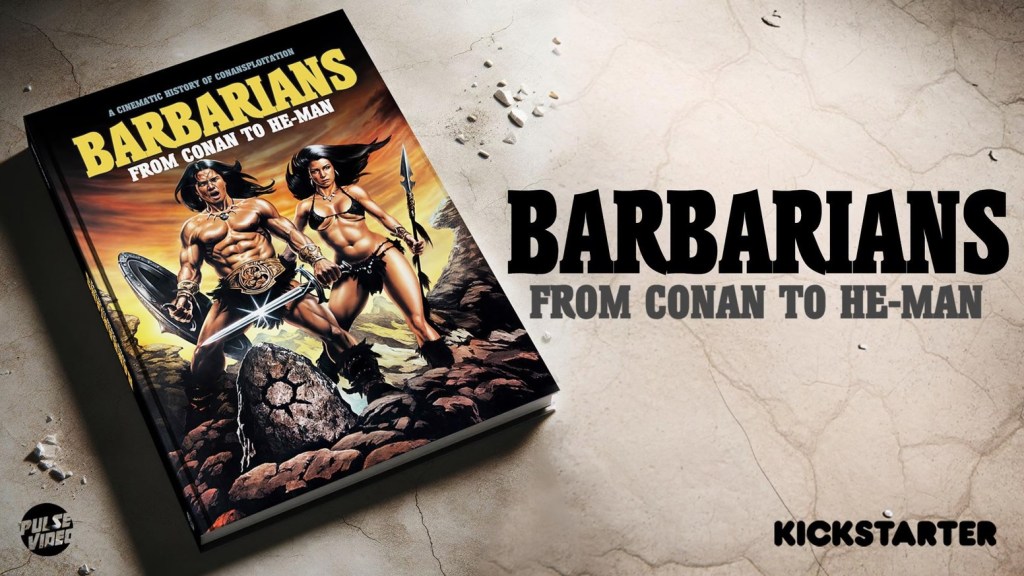
Yesterday I received my copy of a Claude Gaillard’s Kickstarter book BARBARIANS: From Conan to He-Man and I’m already enjoying the thoughts its provoking.
The movie Dead Poets Society shared Walt Whitman’s defiant YAWP that is ours to shout over the rooftops of the world. But I didn’t know much about this YAWP myself. The civilization… the “cult”ure I was in at the time had redefined this YAWP and it was years until I understood what it meant.
In the book, Claude writes: “Visible and presumed strength – as well as violence – form the core of the barbaric operas. This idealized barbarism undoubtedly sheds light on our psyches, revealing the primal instincts that centuries of Western cultural construction have attempted to conceal: the animality from which we mistakenly believed we have divorced, but which resurfaces with each historical upheaval. Freedom – individual freedom – is priceless. Through the barbarian characters and for the duration of a film, we thus consented to sacrifice a considerable part of what makes our societies, but which we sometimes perceive as chains. When the lights of the movie theater turn back on, we hurriedly return to the sweet servitude of our modern world with one certainty in mind: to live without faith, without law, without God, without a master, must be an exhausting experience. A constant struggle we don’t really want to experience, but to which we still aspire! The human soul doesn’t mind a contradiction.“
This contradiction reveals itself in our entertainment selections. Comic book characters like the Punisher, or literary-to-screen heroes like Jack Reacher show the modern day equivalent of a righteous barbarian, a self-sufficient, self-answering vigilante, who can stand up for the innocent, literally might making right.
Reminds me of Jordan Peterson’s comments on might not only making right, but as the only way to be right.
However this can create a contradiction as might isn’t always right.
I’ve met Mike Pence… and agree or disagree with the man.. he is a man, a human, just like you or me… an angry mob chanting “Hang Mike Pence” isn’t the freedom that Conan, Jack Reacher or other barbarians offer us.
So the barbarian is a contradiction as a role model. Claude writes that the barbarian “connotated, the foreigner, the invader, the other, as well as the savage and the cruel, the uncouth and the uncultured.“
Ragnar and his pagan ways exemplifies this contradiction… he is foreigner and invader… but his curiosity and drive to learn spares one life and opens a new world of politics and expansion. Old King Conan takes the throne.
So how does this tension play out in every day life? As parents, we inculcate children whom we dwarf with our size and power. We all come in to life completely helpless, depending on the power of adults to feed us, change us, raise us, support us. The adults in the room are right, even if they are wrong. The adults in the room are like gods to us, until we finally grow ourselves and realize they are fallible just like us. Perhaps they didn’t even want to be the adults in the room… had not processed their own journey to parenthood, responsibility and took their trauma out on the ones they were meant to protect.
“Freedom – individual freedom – is priceless” writes Claude and the barbarian expresses that freedom, by his otherness. His tongue is different. He doesn’t care for the local cultures or customs. He sees raw assets in the monuments. He takes the value out of the symbols and reduces them to physical raw material.
2 Kings 25:8-21 The Destruction of the Temple
8 On the seventh day of the fifth month of the nineteenth year of King Nebuchadnezzar of Babylonia, Nebuzaradan, adviser to the king and commander of his army, entered Jerusalem. 9 He burned down the Temple, the palace, and the houses of all the important people in Jerusalem, 10 and his soldiers tore down the city walls. 11 Then Nebuzaradan took away to Babylonia the people who were left in the city, the remaining skilled workers,[b] and those who had deserted to the Babylonians. 12 But he left in Judah some of the poorest people, who owned no property, and put them to work in the vineyards and fields.

13 The Babylonians broke in pieces the bronze columns and the carts that were in the Temple, together with the large bronze tank, and they took all the bronze to Babylon. 14 They also took away the shovels and the ash containers used in cleaning the altar, the tools used in tending the lamps, the bowls used for catching the blood from the sacrifices, the bowls used for burning incense, and all the other bronze articles used in the Temple service. 15 They took away everything that was made of gold or silver, including the small bowls and the pans used for carrying live coals. 16 The bronze objects that King Solomon had made for the Temple—the two columns, the carts, and the large tank—were too heavy to weigh. 17 The two columns were identical: each one was 27 feet high, with a bronze capital on top, 4½ feet high. All around each capital was a bronze grillwork decorated with pomegranates made of bronze.

18 In addition, Nebuzaradan, the commanding officer, took away as prisoners Seraiah the High Priest, Zephaniah the priest next in rank, and the three other important Temple officials. 19 From the city he took the officer who had been in command of the troops, five of the king's personal advisers who were still in the city, the commander's assistant, who was in charge of military records, and sixty other important men. 20 Nebuzaradan took them to the king of Babylonia, who was in the city of Riblah 21 in the territory of Hamath. There the king had them beaten and put to death.

So the people of Judah were carried away from their land into exile."
As the Babylonians and the Jan 6 rioters show, human might does not always make right. Power corrupts… but the barbarian holds some promise that our raw strength can be used for good.
Claude writes: “It is worth noting that the uniqueness of the barbarian and the allure he held over the public went beyond his affinity for swift self-justice. No, it was all part of something larger, more potent and more radical. Barbarian cinema took us back to square one. These journeys into primitive and medieval times, albeit imaginary, opened the door to a little more freedom than the constraints of today’s world allow. Freed from the shackles of civilization, predetermined rules and sometimes burdensome political correctness, one could reclaim control of the destiny. The concept of a blank slate awaiting new narratives, lay at the heart of post-apocalyptic cinema – a genre closely related to the celebration of this new barbaric age.“
It is this “blank slate” what if there were no rules aspect of barbarism that I do embrace… in every situation, using my might to make (as best as I can interpret it) right and using that strength to protect and raise those to also wield their freedom aright. To help them to sound their own YAWP across the roofs of the world. And to make this world, whatever it is, a better place for all of us… as Walt Whitman says, in the same poem….
I bequeath myself to the dirt to grow from the grass I love,
If you want me again look for me under your boot-soles.

You will hardly know who I am or what I mean,
But I shall be good health to you nevertheless,
And filter and fibre your blood.
 Andy Heavilin